Review Article | | Peer-Reviewed

A Review of Factors Governing the Stability of Crude Oil Emulsion

Received: 12 October 2025     Accepted: 22 October 2025     Published: 28 November 2025
Views:       Downloads:
Abstract

Petroleum emulsions are complex and heterogeneous dispersions that frequently occur during crude oil production, transportation, and processing. These systems most commonly exist as water-in-oil (W/O) emulsions, in which fine droplets of water are dispersed within the continuous oil phase. The formation and stability of such emulsions are governed by a combination of chemical and physical factors. Natural surface-active components present in crude oil, particularly asphaltenes and resins, play a crucial role in stabilizing these emulsions by adsorbing at the oil–water interface and forming rigid, viscoelastic interfacial films that hinder droplet coalescence. Resins not only enhance the solubility and dispersibility of asphaltenes but also influence interfacial rheology and film strength. In addition to these organic stabilizers, the presence of fine mineral solids, wax crystals, and trace metals can further contribute to emulsion stability by acting as physical barriers at the interface. Physical conditions such as shear rate, temperature, pH, salinity, and mineral composition of the formation water also significantly affect emulsion characteristics and lifetime. Although petroleum emulsions are not thermodynamically stable, they can remain intact for extended periods because of the development of strong interfacial barriers. Gaining a thorough understanding of these stabilization mechanisms is crucial for accurately predicting emulsion behavior and for designing effective demulsification and separation methods in petroleum processing.

Published in International Journal of Oil, Gas and Coal Engineering (Volume 13, Issue 4)
DOI 10.11648/j.ogce.20251304.12
Page(s) 70-73
Creative Commons

This is an Open Access article, distributed under the terms of the Creative Commons Attribution 4.0 International License (http://creativecommons.org/licenses/by/4.0/), which permits unrestricted use, distribution and reproduction in any medium or format, provided the original work is properly cited.

Copyright

Copyright © The Author(s), 2025. Published by Science Publishing Group

Keywords

Petroleum Emulsions, Asphaltenes, Resins, Stability, Interfacial Phenomena

1. Introduction
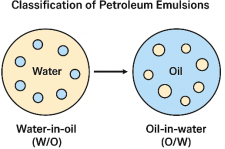
Emulsions are colloidal systems formed when one immiscible liquid is finely dispersed within another. In petroleum production, the most common type is the water-in-oil (W/O) emulsion, which arises naturally during crude oil extraction, transport, and processing. Oil-in-water (O/W) crude oil emulsions are relatively uncommon in the industry, and thus are not the focus of this article. However, they are occasionally employed as a method to transport heavy crude oil, converting water-in-oil (W/O) emulsions into O/W systems (Figure 1). These emulsions are typically formed under high shear conditions, turbulence, pressure fluctuations, and temperature changes. Their presence causes serious operational challenges, including increased viscosity, corrosion, reduced production efficiency, and difficulties in oil–water separation .
Figure 1. Types of Crude oil emulsions.
The stability of petroleum emulsions depends on both the chemical composition of the crude oil and the physical conditions during formation. Naturally occurring surface-active materials such as asphaltenes, resins, waxes, and fine solids adsorb at the oil–water interface, forming rigid films that prevent droplet coalescence. In addition, factors like shear rate, temperature, salinity, and pH influence the extent and strength of emulsion stability .
A clear understanding of the chemical and physicochemical causes of emulsion formation is essential for developing effective separation and demulsification methods. This paper reviews the primary components and mechanisms responsible for the formation and stabilization of petroleum emulsions, emphasizing the roles of asphaltenes, resins, and key physical factors.
2. Chemical Components of Crude Oil Responsible for Emulsion Stability
2.1. Asphaltenes
Asphaltenes are among the most important components responsible for emulsion stabilization. They are defined as the fraction of crude oil that is insoluble in light alkanes (such as n-heptane or n-pentane) but soluble in aromatic solvents like toluene and benzene. Chemically, asphaltenes are large polyaromatic molecules containing heteroatoms such as oxygen, nitrogen, and sulphur, as well as trace metals like iron, nickel, and vanadium. Their molecular weight can range from a few hundred to several thousand Daltons .
When crude oil is mixed with water under shear or agitation, asphaltene molecules migrate to the oil–water interface because of their amphiphilic nature. The aromatic core of the molecule remains in the oil phase, while polar functional groups orient toward the water phase. This leads to the formation of a rigid, viscoelastic interfacial film that resists deformation and coalescence .
The stability of emulsions is strongly affected by:
1) Asphaltene concentration: Higher asphaltene content generally increases emulsion stability.
2) Aromaticity and polarity: More polar asphaltenes form stronger interfacial films.
3) Degree of aggregation: When asphaltenes self-associate into larger clusters, they form thicker interfacial layers that are difficult to break .
Furthermore, temperature and solvent composition influence asphaltene behaviour. At higher temperatures, asphaltenes may partially desorb from the interface, leading to partial destabilization. In contrast, at lower temperatures or in crude oils with low aromatic content, asphaltenes become less soluble and tend to aggregate, forming extremely stable emulsions known as tight emulsions.
In many cases, the interfacial film formed by asphaltenes acts like a semi-solid membrane. It exhibits high interfacial elasticity and can trap small droplets within, further enhancing stability. Studies using techniques such as interfacial rheology and microscopy have shown that these films can persist even after long aging times, explaining why emulsions containing high asphaltene concentrations are very difficult to demulsify .
2.2. Resins
Resins are another crucial group of surface-active molecules found in crude oil. They are less polar and less aromatic than asphaltenes but play a vital role in controlling their behaviour. Structurally, resins contain aromatic and aliphatic rings with heteroatoms and polar functional groups, making them moderately amphiphilic.
Resins act as natural dispersing agents (peptizers) that keep asphaltene molecules well-dispersed in the oil phase, preventing them from aggregating and precipitating. However, their role in emulsion stability is dual and depends on the resin-to-asphaltene ratio:
1) When present in balanced proportions, resins stabilize asphaltenes in the oil, reducing their tendency to form thick interfacial films.
2) When resins are depleted, asphaltenes become unstable and migrate more strongly to the interface, increasing emulsion stability.
At the interface, resins can co-adsorb with asphaltenes, forming mixed interfacial films. These films have unique viscoelastic properties — more flexible than pure asphaltene films but still strong enough to resist coalescence. This cooperative behavior explains why even resins alone, without asphaltenes, can contribute to moderate emulsion stability .
Additionally, resins influence interfacial tension and surface charge. They can lower the oil–water interfacial tension, which facilitates the formation of smaller droplets during emulsification. The resulting smaller droplet size increases the total interfacial area, further stabilizing the emulsion.
2.3. Other Natural Stabilizing Components
Besides asphaltenes and resins, crude oil contains several other compounds that can enhance emulsion stability:
Waxes:
Waxes are long-chain hydrocarbons that can crystallize at low temperatures. The presence of wax crystals increases viscosity and may trap water droplets within a semi-solid matrix, leading to high mechanical stability.
Organic Acids and Naphthenates: These components act as natural surfactants that ionize at the oil–water interface. Their carboxylate groups interact with metal cations in produced water (such as Na⁺, Ca²⁺, Mg²⁺), forming metal naphthenates that further strengthen the interfacial film.
Fine Solid Particles: Clays, silicates, iron oxides, and corrosion products can adsorb irreversibly at droplet interfaces, creating Pickering emulsions. In such systems, solid particles act as a physical barrier to droplet coalescence. These emulsions are among the most stable types encountered in petroleum operations and are often resistant to both chemical and thermal demulsification .
3. Physicochemical Factors Influencing Emulsion Stability
High shear during production, pumping, or transportation causes droplet breakup and dispersion, leading to finer emulsions with greater stability due to increased interfacial area. Continuous mechanical agitation prevents coalescence and maintains kinetic stability. Temperature strongly affects viscosity and interfacial tension. Higher temperatures generally reduce emulsion stability by lowering viscosity and promoting coalescence. Conversely, cooling can solidify waxes and strengthen interfacial films. The ionic strength and pH of the aqueous phase influence electrostatic interactions between droplets. High salinity can compress electrical double layers, leading to coalescence, while low salinity may enhance repulsion and stability. For example, according to the research conducted by Strassner (1968), the rigid interfacial layer formed by asphaltenes is stronger in acidic environments, of medium strength at neutral pH, and very weak in alkaline conditions. Due to the complex interactions among these factors, emulsions are often thermodynamically unstable, yet they can exhibit high kinetic stability. This makes their breakdown difficult and directly ties the effectiveness of the demulsification process to the optimization of these conditions . Contact with mineral surfaces in the reservoir or pipelines introduces fine particles that act as stabilizing agents. Clays and silicates are especially effective at forming rigid interfacial barriers.
4. Interfacial Phenomena
It should be specifically emphasized that the presence of surfactants leads to the formation of internal physicochemical mechanisms that ensure the stability of emulsions. These mechanisms include steric repulsion, electrostatic repulsion, thin film stabilization, and the Marangoni–Gibbs effect. These mechanisms increase the kinetic stability of the emulsion by preventing the coalescence of droplets.
Steric stabilization is mainly observed in systems stabilized with non-ionic surfactants and polymers. In this mechanism, dispersed water droplets are coated with surfactant molecules, and the tail portion of the surfactant prevents the droplets from coming into close contact with each other. This type of stabilization is particularly important in water–oil emulsions, as the non-polar part of the stabilizer interacts strongly with the oil phase, while the polar part interacts with the aqueous phase.
The Marangoni–Gibbs effect ensures the continuity of emulsions because it prevents the drainage of the continuous phase between droplets moving in opposite directions. This phenomenon is associated with changes in the surface area of droplets as they approach each other. When droplets form parallel surfaces, the thin film between them attempts to drain, but the adsorption of surfactants and the rigidity of the interfacial film maintain the stability of the emulsion. The formation of a viscoelastic and rigid layer surrounds the water droplets and prevents them from coalescing into larger droplets. This process is complex and is mainly related to the chemical composition of asphaltenes, their solubility properties, and the rates of diffusion and adsorption.
Electrostatic forces arise from the interaction between the electric double layers surrounding charged droplets, preventing the droplets from coming close together. This mechanism is related to the adsorption of ionic surfactants. However, in water–oil emulsions, electrostatic repulsion does not play a primary role, since the dielectric constant of the continuous phase is low. In such cases, the stability of the emulsion depends more on the rigidity of the interfacial layer .
5. Conclusion
Petroleum emulsions form and remain stable due to a complex interplay between the chemical composition of the crude oil and physical conditions during production. Asphaltenes and resins are the main natural stabilizers, forming interfacial films that resist droplet coalescence. Waxes, acids, and fine solids can further enhance this stability. Physical factors such as shear, temperature, salinity, and mineral content also play critical roles in determining emulsion behavior. A thorough understanding of these mechanisms is essential for predicting emulsion properties and designing efficient demulsification and separation strategies in petroleum production and processing systems.
Abbreviations

O/W

Oil in Water Emulsion

W/O

Water in Oil Emulsion

PR

Polyoxyethylene Polyoxypropylene Quaternized Polyoxyolefins

ND-12

Specific Demulsifier for Oily Rocks of Azrbaijan Republic

Conflicts of Interest
The authors declare no conflict of interest.
References
[1] Sjoblom, J “Handbook of Emulsion Technology”.
[2] Reza Zolfaghari, A. Fakhrul-Razi, Abdullah Luqman Chuah, Said Elnashaie “Demulsification techniques of water-in-oil and oil-in-water emulsions in petroleum industry”.
[3] Mervin F Fingas, Ben Fieldhouse, James Lane, Josep V. Mullin What Causes the Formation of Water-in-Oil Emulsions Conference Paper in International Oil Spill Conference Proceedings · January 2005.
[4] Mina Seidy-Esfahlan, Seyyed Alireza Tabatabaei-Nezhad, Elnaz Khodapanah “Comprehensive review of enhanced oil recovery strategies for heavy oil and bitumen reservoirs in various countries: Global perspectives, challenges, and solutions”.
[5] Schramm, L. L. “Emulsions: Fundamentals and Applications in the Petroleum Industry”.
[6] Chukwuemeka Nwadinigwe, Theresa Ngozi Alumona “NAASAR procedure for quantitative assessment of n-alkanes, asphaltenes and resins in crudes”.
[7] Edris Joonaki, Aliakbar Hassanpouryouzband, Rod Burgass, Alfred Hase, and Bahman Tohidi “Effects of Waxes and the Related Chemicals on Asphaltene Aggregation and Deposition Phenomena: Experimental and Modeling Studies”.
[8] Tadros, T. F. (2013) “Emulsion Formation, Stability and Rheology”.
[9] Sweeta Akbari, Abdurahman Hamid Nour “Emulsion types, stability mechanisms and rheology”.
[10] Strassner, J. E., Effect of pH on interfacial films and stability of crude oil-water emulsions. JPT 303, March (1968).
[11] Moradi, M., Alvarado, V., Huzurbazar, S. “Effect of salinity on water-in-crude oil emulsion: Evaluation through drop-size distribution proxy”. Energy & Fuels, 25, 260-268 (2011).
[12] Yan Peng, Xiangyu Zhang, Lihua Cheng, Hong Zhang, Jieyun Tang, Hong Chen, Qinzhen Fan, Xinping Ouyan “Effect of Asphaltenes on the Stability of Water in Crude Oil Emulsions”.
[13] Mahmoudi Alemi, Mohammadi “Experimental Study on Water‑in‑Oil Emulsion Stability Induced by Asphaltene Colloids in Heavy Oil”.
[14] Soroush Ahmadi, Azizollah Khormali “Petroleum Emulsion Stability and Separation Strategies”.
[15] Al-Sakkaf, Onaizi “Effects of emulsification factors on the characteristics of crude oil emulsions stabilized by chemical and biosurfactants”.
Cite This Article
  • APA Style

    Nabizada, O., Movsumzada, A. (2025). A Review of Factors Governing the Stability of Crude Oil Emulsion. International Journal of Oil, Gas and Coal Engineering, 13(4), 70-73. https://doi.org/10.11648/j.ogce.20251304.12

    Copy | Download

    ACS Style

    Nabizada, O.; Movsumzada, A. A Review of Factors Governing the Stability of Crude Oil Emulsion. Int. J. Oil Gas Coal Eng. 2025, 13(4), 70-73. doi: 10.11648/j.ogce.20251304.12

    Copy | Download

    AMA Style

    Nabizada O, Movsumzada A. A Review of Factors Governing the Stability of Crude Oil Emulsion. Int J Oil Gas Coal Eng. 2025;13(4):70-73. doi: 10.11648/j.ogce.20251304.12

    Copy | Download

  • @article{10.11648/j.ogce.20251304.12,
      author = {Orkhan Nabizada and Anvar Movsumzada},
      title = {A Review of Factors Governing the Stability of Crude Oil Emulsion},
      journal = {International Journal of Oil, Gas and Coal Engineering},
      volume = {13},
      number = {4},
      pages = {70-73},
      doi = {10.11648/j.ogce.20251304.12},
      url = {https://doi.org/10.11648/j.ogce.20251304.12},
      eprint = {https://article.sciencepublishinggroup.com/pdf/10.11648.j.ogce.20251304.12},
      abstract = {Petroleum emulsions are complex and heterogeneous dispersions that frequently occur during crude oil production, transportation, and processing. These systems most commonly exist as water-in-oil (W/O) emulsions, in which fine droplets of water are dispersed within the continuous oil phase. The formation and stability of such emulsions are governed by a combination of chemical and physical factors. Natural surface-active components present in crude oil, particularly asphaltenes and resins, play a crucial role in stabilizing these emulsions by adsorbing at the oil–water interface and forming rigid, viscoelastic interfacial films that hinder droplet coalescence. Resins not only enhance the solubility and dispersibility of asphaltenes but also influence interfacial rheology and film strength. In addition to these organic stabilizers, the presence of fine mineral solids, wax crystals, and trace metals can further contribute to emulsion stability by acting as physical barriers at the interface. Physical conditions such as shear rate, temperature, pH, salinity, and mineral composition of the formation water also significantly affect emulsion characteristics and lifetime. Although petroleum emulsions are not thermodynamically stable, they can remain intact for extended periods because of the development of strong interfacial barriers. Gaining a thorough understanding of these stabilization mechanisms is crucial for accurately predicting emulsion behavior and for designing effective demulsification and separation methods in petroleum processing.},
     year = {2025}
    }
    

    Copy | Download

  • TY  - JOUR
    T1  - A Review of Factors Governing the Stability of Crude Oil Emulsion
    AU  - Orkhan Nabizada
    AU  - Anvar Movsumzada
    Y1  - 2025/11/28
    PY  - 2025
    N1  - https://doi.org/10.11648/j.ogce.20251304.12
    DO  - 10.11648/j.ogce.20251304.12
    T2  - International Journal of Oil, Gas and Coal Engineering
    JF  - International Journal of Oil, Gas and Coal Engineering
    JO  - International Journal of Oil, Gas and Coal Engineering
    SP  - 70
    EP  - 73
    PB  - Science Publishing Group
    SN  - 2376-7677
    UR  - https://doi.org/10.11648/j.ogce.20251304.12
    AB  - Petroleum emulsions are complex and heterogeneous dispersions that frequently occur during crude oil production, transportation, and processing. These systems most commonly exist as water-in-oil (W/O) emulsions, in which fine droplets of water are dispersed within the continuous oil phase. The formation and stability of such emulsions are governed by a combination of chemical and physical factors. Natural surface-active components present in crude oil, particularly asphaltenes and resins, play a crucial role in stabilizing these emulsions by adsorbing at the oil–water interface and forming rigid, viscoelastic interfacial films that hinder droplet coalescence. Resins not only enhance the solubility and dispersibility of asphaltenes but also influence interfacial rheology and film strength. In addition to these organic stabilizers, the presence of fine mineral solids, wax crystals, and trace metals can further contribute to emulsion stability by acting as physical barriers at the interface. Physical conditions such as shear rate, temperature, pH, salinity, and mineral composition of the formation water also significantly affect emulsion characteristics and lifetime. Although petroleum emulsions are not thermodynamically stable, they can remain intact for extended periods because of the development of strong interfacial barriers. Gaining a thorough understanding of these stabilization mechanisms is crucial for accurately predicting emulsion behavior and for designing effective demulsification and separation methods in petroleum processing.
    VL  - 13
    IS  - 4
    ER  - 

    Copy | Download

Author Information
  • Department of Hydrogas Dynamics of Layer Systems, Oil and Gas Institute of the Ministry of Education of Azerbaijan, Baku, Azerbaijan


  • Department of Hydrogas Dynamics of Layer Systems, Oil and Gas Institute of the Ministry of Education of Azerbaijan, Baku, Azerbaijan